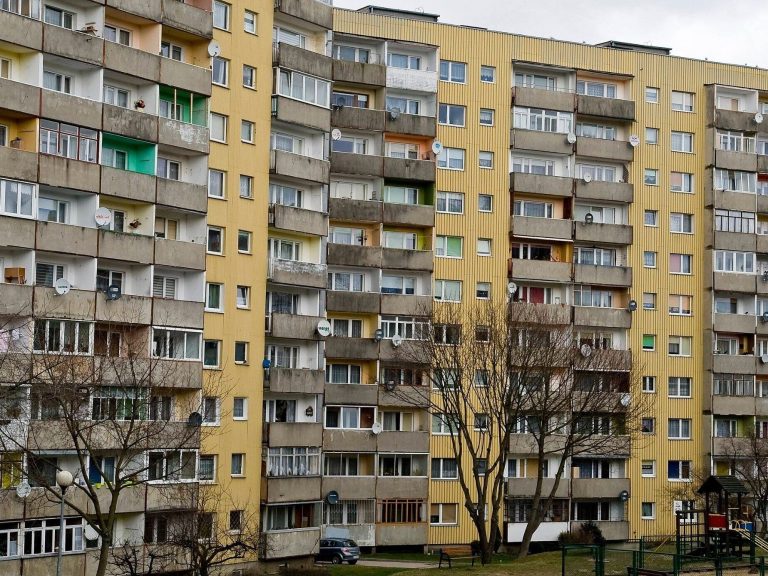
Your own “M” at all costs. Poles pay for this with narrowness

Poles have their own apartments, but they often lack space. Experts point out why we live in tighter conditions than residents of many EU countries.
Small is beautiful? Perhaps in the world of design. Not necessarily in an apartment. Especially when “small” means one room shared with siblings, parents or your own children. Over the years, Poland has developed a specific paradox: we have an exceptionally large number of owner-occupied apartments, relatively few households overburdened with the costs of maintaining them, and at the same time we are among the European leaders in terms of overpopulation.
Where does this phenomenon come from? The answer lies not only in real estate prices, but also in the legacy of the Polish People’s Republic and the deeply rooted culture of having one’s own “M” in Poland. And although the Polish economy has caught up with the European leaders in many respects, in terms of the area where we live, we are lagging behind. What are the reasons for this?
An apartment does not consume the household budget. But is this really good news?
If we look at the Polish housing market solely through the prism of living costs, there are indeed few reasons to complain. It is relatively rare for a flat to consume more than 40% of the space on the Vistula River. household disposable income.
– Expenditures on loan installments, utilities, insurance and renovations consume over 40 percent. disposable income only in the case of 4.1 percent Poles – notes Gabriela Prygiel, expert of the RynekPierwotny.pl portal.
In the entire European Union, only Slovakia and Slovenia (3.5 percent each), Croatia (3.2 percent) and Cyprus (2.4 percent) have a lower rate. Compared to our western neighbors, we can look like a housing paradise. In France, the rate reaches 6.4 percent, in Germany 11.2 percent, and in Denmark as much as 23.4 percent.
However, statistics have a deeper meaning here. Because the fact that an apartment does not consume a huge part of the household budget does not mean that it is easy to buy. Especially since Poles live spaciously.
Cheap to maintain, expensive to get into
And this is where the first, quite optimistic story ends. Poland boasts a low percentage of households overburdened by housing costs, but at the same time, entering the real estate market has become an increasingly difficult task for many people.
The reason is quite simple: a huge part of Poles lives in premises that were bought a long time ago and are no longer burdened with a loan. Their owners do not have to face the same financial burden as people who are just trying to buy an apartment.
Eurostat data shows that 75 percent Poles live in a property that is not subject to a loan. This gives us the fourth result in the European Union. So we are talking about millions of households whose budget is not reduced by the monthly installment. In addition, there has been a solid increase in wages in recent years and still relatively low utility bills.
However, this is good news especially for those who already have the keys to their own apartment. For those just looking to get their hands on one, the picture looks much less rosy.
– The above indicator measures cost overload, not the entry barrier. In Polish conditions, the bottleneck is the latter, and Poland fares less favorably in this ranking. Apartment prices have increased by approximately 88% in 7 years. on the primary market (Q1 2026 vs. Q1 2019), which gives us the inglorious 5th place among the fastest-growing apartments – explains Gabriela Prygiel.
In short: anyone who already lives on their own can look at the statistics with some peace of mind. Those who are just trying to enter the market have much more reasons to reflect.
The legacy of the Polish People’s Republic is still going strong. Poles want to have their own “M”
There is one more piece to this puzzle. And this time it’s not about prices or installment amounts. It’s about a belief that in Poland is almost as strong as the penchant for complaining about housing prices: it’s best to have your own “M”. Because ownership is more than just a form of satisfying housing needs. It is a symbol of stability, security and success in life. It is also one of the most visible remnants of the era when your own apartment was a scarce commodity, and acquiring it could be a lifelong project.
The legacy of the Polish People’s Republic did not disappear with the transformation. It is visible, among other things, in the structure of apartment ownership. 87 percent Poles live in their own place, and only 13 percent rents. For comparison, in Germany the proportions are close to 50:50.
Why such a big difference? According to the expert of the RynekPierwotny.pl portal, what is important is the “culture of ownership” passed down from generation to generation and additionally strengthened by the political transformation, including the enfranchisement of cooperative and municipal resources in the 1990s.
This is also one of the reasons why institutional leasing may develop slower in Poland than in Western Europe. The Private Rented Sector competes not only with fragmented private rentals, but above all with the deeply rooted belief that renting an apartment is a transitional stage. The goal is to be ownership.
And here another paradox appears.
– This has further consequences. Since renting functions in people’s minds as a transitional stage, young people postpone the moment of independence. People after graduation, with a job and their own income, still living with their parents, have their own definition of “nesters”. In Poland, 51% of them fall into the 25-34 age group. This is the fourth result in the EU; this phenomenon occurs more often only in Croatia, Greece and Slovakia. The average time we move out of the family home is around the age of 27, adds an expert from the RynekPierwotny.pl website.
When your own apartment is out of reach, you stay in your parents’ room
The young Pole is therefore faced with a rather peculiar choice. Owning your own apartment is expensive, renting is often treated as a temporary solution, and the social expectation of having your own home remains strong. As a result, the third option – staying in the family home – turns out to be the cheapest and most accessible solution.
However, the bill for this decision does not necessarily come in the form of a transfer to the bank or the apartment owner. Sometimes you pay for it in square meters and subsequent independence.
There are 1.2 rooms per average Pole compared to the EU average of 1.7. Approximately 31% of people live in premises considered overcrowded by Eurostat. Poles, while the EU average is approximately 17%.
And suddenly the previously very favorable statistics regarding the cost of living start to look completely different. Perhaps housing doesn’t take up a huge portion of your income because its costs are shared among more people. So it’s not always cheap – sometimes it’s just tight.
– A low level of housing cost overload does not necessarily mean that living in Poland is cheap. Rather, it masks the way we organize households, where the costs of maintaining a flat are spread over a larger number of people. Therefore, we pay a high price not only in financial terms, but also in the way we organize our housing life: later becoming independent, co-living in larger households or limited space – sums up Prygiel.
The Polish housing problem is not limited to how much a square meter costs. It is also a story about how we have learned to live over the decades, what we consider a success in life and why owning “M” still beats renting. However, sometimes we pay for this housing philosophy not with installments, but with space, privacy and subsequent entry into adulthood.